

AI demand is no longer just a data center story. At electronica 2026, Fusion heard it reaching the analog, discrete, passive and legacy memory parts that automotive, industrial and energy manufacturers depend on. For procurement teams, the risk in 2027 is less about GPUs and more about the everyday parts on their BOMs.
This recap brings together what customers told Fusion at our booth and what independent analyst Claus Aasholm explained in two live sessions, then lays out what procurement teams can do about it now.
Fusion at electronica 2026
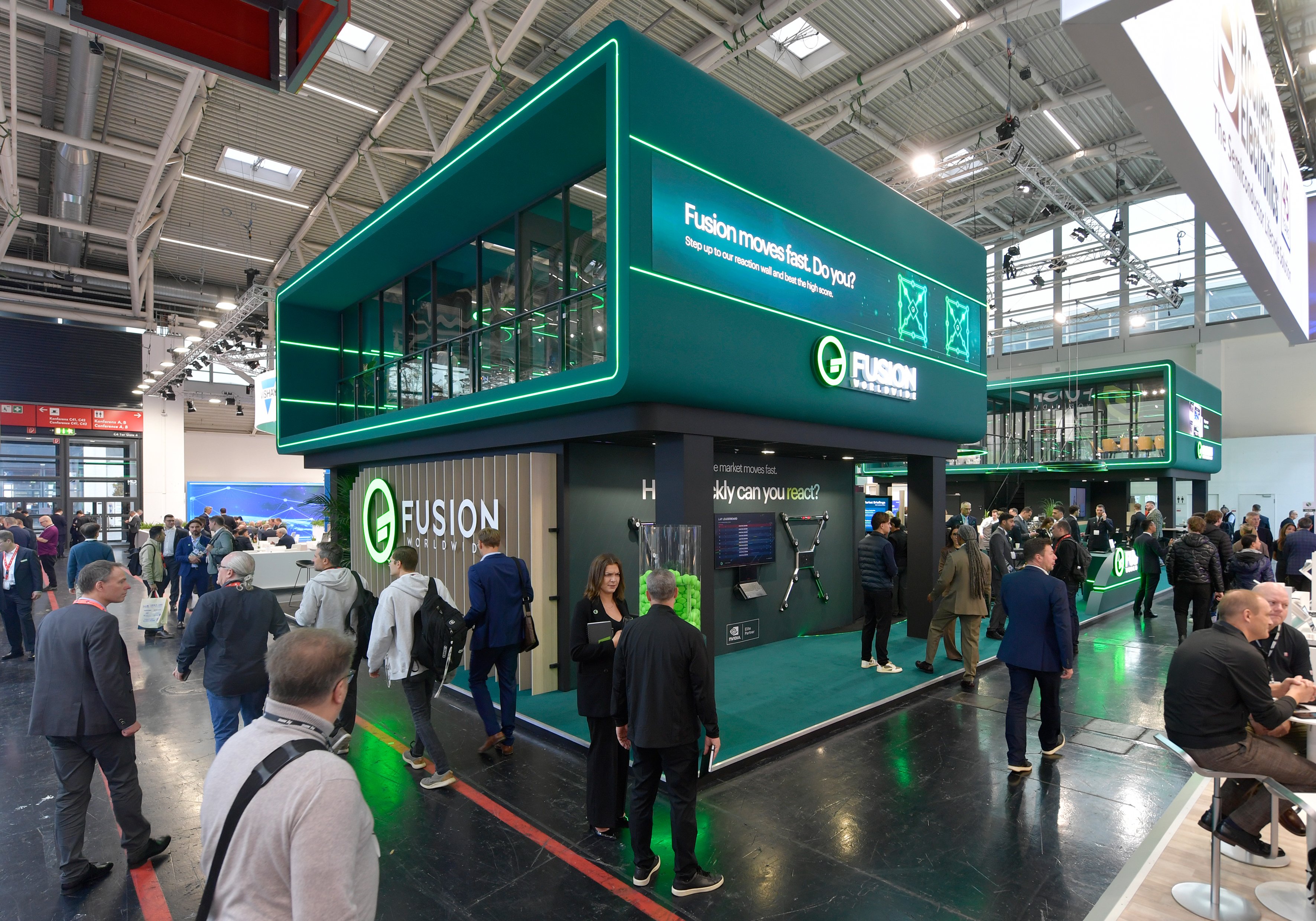
electronica 2026 ran November 10 to 13 at Messe München and drew more than 86,000 visitors and 3,512 exhibitors, according to the organizer's final report. Fusion went to Munich to hear directly from customers about what they are facing heading into 2027.
Our booth in Hall C4, Booth 279 was set up for conversation. Andrew Czuczwa, Fusion's Market Research Manager, spent all four days meeting with customers to compare notes on lead times, allocations and 2027 planning. Independent analyst Claus Aasholm joined him for two live sessions: "The Memory Era: Is the Semiconductor Cycle Dead?" and "Starved by AI? The Squeeze on Europe's Core Industries." Between meetings, visitors stopped by for daily happy hours, unlimited coffee, and a racecar simulator and reaction game with daily prize winners.
What we heard on the floor
Customers came to the booth with practical questions about 2027. Which parts will be hardest to get? How far will lead times stretch? Where does buffer stock make sense?
Across those conversations, a clear pattern emerged. The pressure starts in analog, extends to legacy memory, and traces back to mature-node capacity. Claus's sessions explained the forces behind each one.
Analog supply: TI decommits are the most immediate risk
The most immediate pressure is in analog. In Andrew's meetings, Texas Instruments, Analog Devices and Diodes Inc. came up more often than any other manufacturer, with MLCC supply close behind.
The most common issue was TI decommits. Customers told Fusion that TI deliveries are frequently pushed at the last minute, often on the day they expect shipment tracking. That timing leaves little room to find another source before production is affected. Fusion's October 2026 Greensheet reported TI and ADI lead times past 52 weeks, and what we heard in Munich was consistent with that data.
Diodes Inc. remains tight, a trend we covered in Diodes Inc. Shortage 2026. On MLCCs, customer feedback matched Fusion's existing risk register: no new signals, but no relief.
What it means for procurement: Confirmed dates on TI and ADI parts are not a guarantee. Single-source analog parts with no buffer stock carry the most risk.
Legacy memory: HBM is pulling capacity away from DDR3 and DDR4
Analog is the pressure buyers are managing today. Legacy memory is the one they are preparing for. Customers told Fusion they expect memory volatility in 2027, with DDR3 and DDR4 allocations already shrinking, and Claus Aasholm's first session, "The Memory Era: Is the Semiconductor Cycle Dead?", explained why.
Claus is the founder of Semiconductor Business Intelligence and one of the industry's most followed independent analysts. He joined Andrew at the booth to follow up on our earlier conversation, Is AI Demand a Bubble?
The industry is 13 quarters into an upturn that, by historical patterns, should be peaking. Growth is still accelerating.
The memory market shows why. Memory makers earn more per wafer on AI memory, so capacity moves there first. TrendForce estimates HBM will account for about 18%, 22% and 30% of DRAM wafer input at the end of 2025, 2026 and 2027 (TrendForce via I-Connect007). With long-term contracts locking up supply and no new fabs expected to produce until 2028, legacy DRAM has little room to grow.
Fusion is already seeing this in the data. In October, Micron's MT41K256M16TW-107 DDR3L reached a 39-week authorized lead time.
What it means for procurement: Long-running designs on DDR3, DDR3L or DDR4 should plan last-time buys or qualify second sources before 2027 allocations are set.
Mature-node capacity: the common cause behind Europe's squeeze
Analog and legacy memory share a common cause: capacity is moving toward AI, and mature-node supply is not growing to replace it. Claus's second session, "Starved by AI? The Squeeze on Europe's Core Industries," looked at what that means for European industry. His view is that the next bottlenecks are forming in parts of the supply chain that get little attention.
He outlined five pressure points:
- Mature-node fab capacity is declining. Older fabs are not being replaced at the pace that analog, power and discrete demand requires.
- Analog and hybrid manufacturers are increasing output. The open question is whether it can keep pace with demand.
- Materials CapEx is "disciplined." Wafer, chemical and substrate suppliers are not expanding ahead of demand.
- Back-end (OSAT) capacity is tight. Assembly and test capacity is being pulled toward advanced AI packaging.
- PCB materials are tightening. This matches the PCBA pressure buyers described at the booth.
These line up with what customers told Fusion on the floor. Buyers reported PCBA materials getting tight and expect mature-node capacity to keep stretching lead times into 2027. Fusion also heard concerns about onsemi and Infineon for the first time. Both are major suppliers of mature-node power and analog parts to Europe's automotive, industrial and energy sectors, which makes them worth watching.
What it means for procurement: Exposure is not limited to a single manufacturer. Buyers with onsemi, Infineon or other mature-node power parts on their BOMs should review alternates now, and confirm board and laminate lead times with their contract manufacturers.
What procurement teams should do now
Taken together, the message from Munich is that 2027 risk is spread across everyday parts rather than concentrated in one category. That makes series-level visibility the starting point. Andrew's recommendation to every customer he met was the same: review high-risk manufacturers, compare their high-risk series against your BOM, and consider buffer stock where exposure is high.
- List high-risk manufacturers. Start with TI, ADI, Diodes Inc., onsemi, Infineon and your MLCC suppliers.
- Match at the series level. Compare at-risk series against your BOM, not just manufacturer names.
- Review legacy memory. Identify DDR3, DDR3L and DDR4 parts and confirm lifecycle status.
- Set buffer targets. Prioritize single-source parts where a late decommit would stop production.
- Qualify alternates early. Approval takes time, and there is more of it now than there will be in mid-2027.
Where Fusion fits
The feedback Andrew heard most in Munich was about granularity. Customers valued that Fusion's market intelligence identifies the exact series at risk for each commodity and manufacturer, which is what makes a BOM review actionable. Fusion supports the next steps through sourcing, inventory management and product lifecycle management, backed by a quality process certified to AS9120B, AS6081 and ISO standards.
Need TI, ADI, Diodes Inc. or legacy memory? Request a quote for current availability, pricing and lead times, plus alternates when parts are tight.
Thank you to everyone who visited the Fusion booth in Munich. Follow Fusion Worldwide on LinkedIn for ongoing market updates and highlights from the show.